
Laser cutting stainless steel: which grades and up to what thickness
Stainless steel laser cuts well, but the choice of grade determines the cutting result, the follow-up operations and how the part behaves in use. In this article you can read which stainless steel grades are processed in sheet, up to what thickness they can be cut, and what to look out for with the cut edge and finishing.
Which stainless steel grades are suitable
With laser cutting stainless steel, the choice of material is usually already determined by the application: corrosion load, temperature, hygiene requirements or strength. For the cutting itself, what matters most is that the sheet is flat, has a constant thickness, and that the film or protective layer is known to production planning.
The following stainless steel grades are processed in sheet at Baas Metaal:
- 1.4301 (304) and 1.4307 (304L): the general workhorse for structural and equipment building, readily weldable and bendable
- 1.4401 (316) and 1.4404 (316L): with molybdenum, for higher corrosion loads such as chloride-containing environments
- 1.4571 (316Ti) and 1.4541 (321): stabilised variants, aimed at higher temperatures
- 1.4462 (duplex 2205): higher strength and better resistance to stress corrosion, but demanding in terms of heat input when welding
- 1.4016, 1.4057, 1.4104, 1.4122, 1.4305 (303) and 1.4310: ferritic, martensitic and free-machining grades for specific applications
Thickness and what it means for your part
The machine limit for stainless steel is 30 mm. That is the upper limit of the installation; whether a specific part is feasible in that thickness depends on the geometry. Small holes, narrow webs and sharp corners need more room in thick plate than in thin sheet.
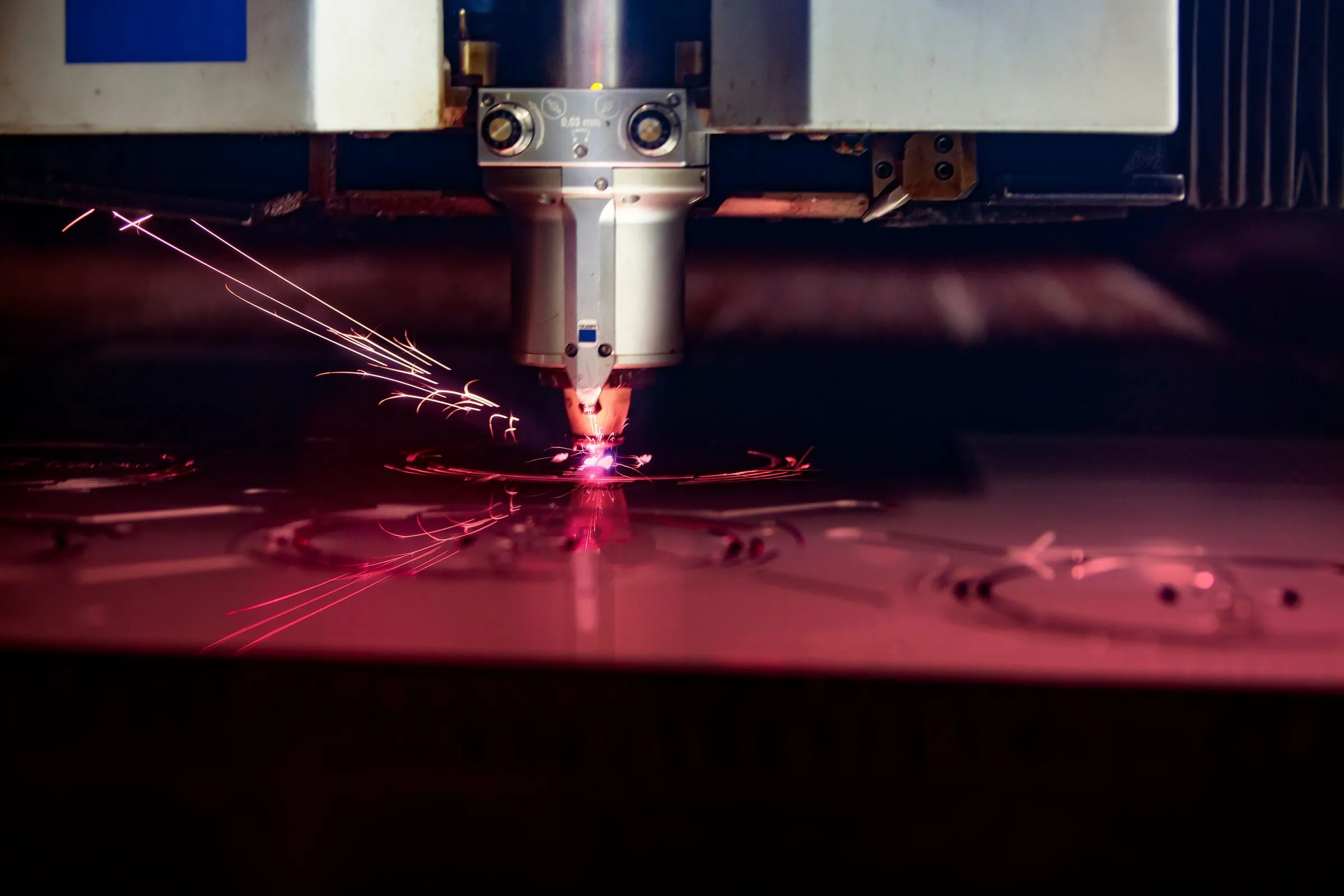
Cutting is done on three TRUMPF laser cutting machines, one of which has a table of 4000 × 2000 mm. As a result, parts up to 4000 mm long can come from a single sheet, without an intermediate weld. For long stainless steel parts that saves a seam and therefore finishing work. You can read more about the machines and the other materials on the laser cutting page.
With thicker stainless steel plate the heat input increases. Bear in mind that narrow, elongated parts in thick plate can distort and that straightening or an extra operation may be needed. For critical parts, indicate which side carries the reference faces.
Cut edge and finishing
Stainless steel is usually cut with an inert cutting gas, which produces a bright, oxide-free cut edge. A slight burr can form on the underside, depending on thickness and contour. Agree whether you want the parts deburred; for manual handling, food applications or follow-up operations that is almost always necessary.
Cutting is often followed by bending and welding. With stainless steel the sequence matters: bending before or after removing the protective film affects scratching, and welding produces heat tint that locally affects the passive layer.
Glass bead blasting is used on stainless steel to remove weld discolouration and the oxide layer, among other things, and to obtain an even matt surface. Bear in mind that blasting gives a uniform look over the whole part; partial blasting leaves a visible difference.
- Indicate which side is the visible side
- State whether parts need to be deburred
- State whether the part is blasted, and whether that happens before or after welding
- For 316L and duplex, state the grade explicitly; visually they cannot be told apart from 304
Points for the enquiry and drawing
A clear enquiry helps production planning work smoothly. The points below come up most often with stainless steel.
- Material grade by material number (for example 1.4404) rather than just "stainless steel"
- Sheet thickness and quantities, including any repeat series
- Bend radii and bending sequence for sheet metal parts; duplex and stabilised grades behave differently from 304
- Surface requirement: as cut, deburred or blasted
- Preventing cross-contamination: mention it if stainless steel and carbon steel occur in the same assembly
Frequently asked questions
Up to what thickness can stainless steel be laser cut?
The machine limit for stainless steel is 30 mm. Whether that thickness is feasible for your part depends on the geometry, such as hole diameters, web widths and the length of narrow parts.
What difference does 304 make compared with 316 when cutting?
For the cutting itself the difference is limited. The difference lies in the application: 316 (1.4401) and 316L (1.4404) contain molybdenum and withstand higher corrosion loads, for example in chloride-containing environments.
Can duplex 2205 be laser cut?
Yes, 1.4462 (duplex 2205) is processed in sheet. In the follow-up operations, pay attention to the higher strength when bending and to the heat input when welding.
How is weld discolouration removed from stainless steel?
Glass bead blasting removes weld discolouration and the oxide layer from stainless steel, among other things, and gives an even matt surface. State in the enquiry whether this is required.
Request
What we need to quote
If something is missing we will ask. If you are not sure yet yourself, we will look at it with you.
- material and thickness
- the quantities involved
- a drawing: DXF, STEP or a dimensioned PDF
- whether the part still needs finishing or assembly